It happens to every avid hiker; at some point they find that they struggle to do the hikes that they used to do with ease. Maybe it’s a cardiac or respiratory condition that slows them down during tough uphills because their circulatory system isn’t delivering the same level of oxygen to their muscles that it used to. Or maybe their knees hurt so much it keeps them from hiking. Either way, the bottom line is that hiking isn’t always the joyful experience that it used to be and so time on the trail starts to taper off.
In my case, it’s the knees complaining during extended steep downhills, which means reconsidering the feasability of attempting some trails that I would really like to experience. It started about ten years ago, and a visit to my doctor resulted in the unsatisfying diagnosis of idiopathic patellofemoral syndrome, which essentially means “I can’t find anything specifically wrong with your knees that explains the pain”. Thanks, that was really helpful.
So to avoid the pain I descend more slowly and use hiking poles to reduce the impact of losing a bit of elevation with every step during lengthy descents. Which is a bother, and is accompanied by thoughts of “What is this going to be like a few years from now?” Answer; it won’t get better.
So when a hiking friend sent me a link to this article in The Verge my interest was piqued; could this upcoming powered exoskeleton for the legs change my hiking experience for the better?
Excited, I went to the Skip website and discovered that I could apply to join a “hiking clinic” and be a test subject for a demanding hike near Squamish in southern British Columbia, which happened to be just a 45 minute drive from where I lived. Skip has partnered with Arc’teryx, the premiere Canadian outdoor clothing company, to bring the product to market by late 2025. Full disclosure; no one is paying me to write this, and I already own multiple pieces of Arc’teryx gear.
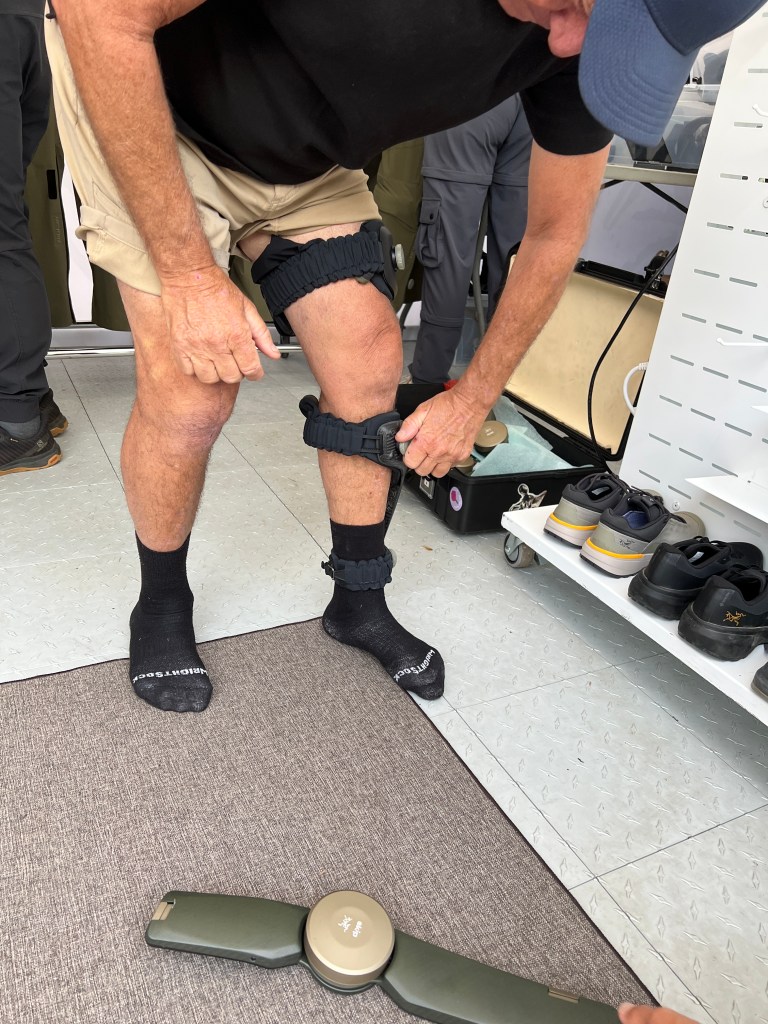
After submitting my application, I got a phone call from Skip co-founder Anna Roumiantseva and learned that I would be part of a test group. A few weeks later on the appointed day I showed up in Squamish, where Arc’teryx has an R&D center, and along with four other people was fitted with the prototype MO/GO™ device. The leg, calf, and ankle straps come in multiple sizes as does the length of the side structural piece that includes the motor, which is positioned level with the knee joint. All of that hardware nicely integrates into a customized version of the Arc’teryx Gamma hiking pant, including a special rear pocket for the battery and software controller.
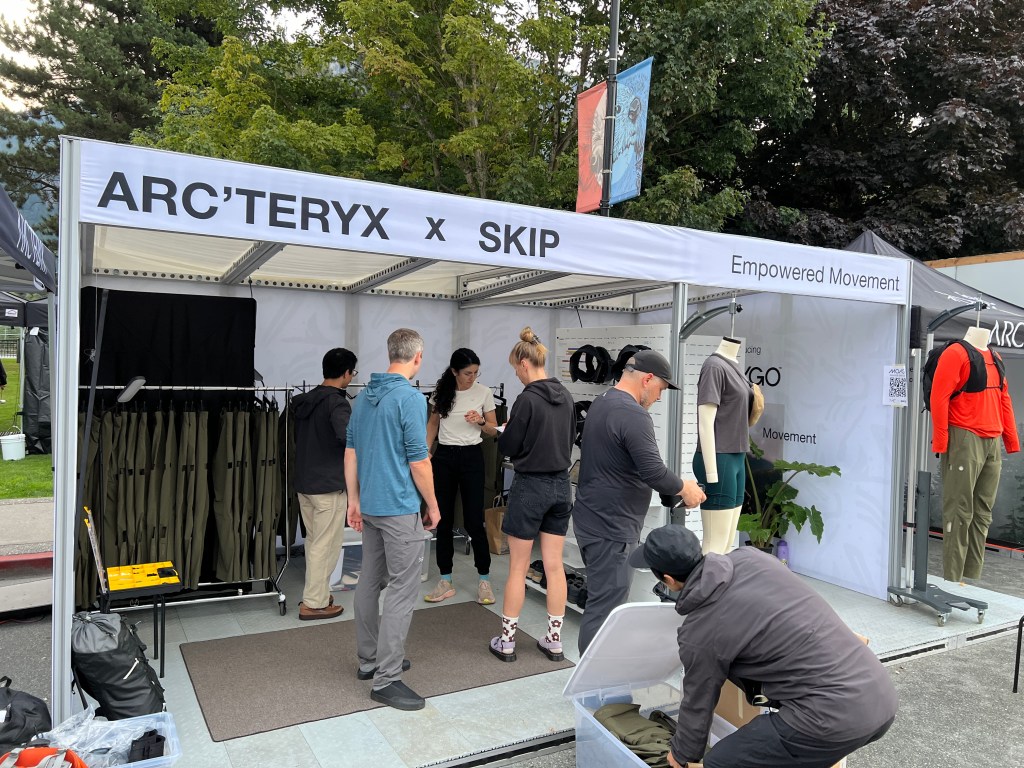

Along with multiple people from Skip and Arc’teryx — some of whom carried tiny laptops that communicated wirelessly to our MO/GO’s for real-time analysis and adjustments on the fly — we started our hike up the Stawamus Chief trail to the First Peak, a non-stop climb up multiple flights of very steep stairs, then rocky, wildly uneven steps, and finally hand-over-hand using fixed chains, for an elevation gain of 538m/1,765ft in just 2.1km/1.3m. I have done tougher trails with even more elevation gain over a similar distance, such as the famous Grouse Grind and the BCMC, but I am slow going up and never look forward to the descent, always enjoying a gondola ride downhill if available!
So how was it? In case you are suffering from TLDR syndrome at this point I’ll jump ahead to the end of the hike;
To my surprise I experienced no knee pain during or after the hike.
On the way down I kept checking in with my knees, thinking that there was going to be at least some discomfort eventually, but no. That never happened. And on the way up I ended up way ahead of the other participants, it was just me and the Arc’teryx product manager and we had to stop and wait for the group.
Now to be clear, wearing the MO/GO is not like strapping a rocket to each leg and effortlessly zooming up the trail. You still have to work to get up the mountain. And the product is very much a work in progress; it’s a prototype that is over a year away from shipping to customers. The way the motor applies force to your upper and lower leg is not yet nearly as smooth as I think it should be, based on my absolutely zero experience with powered exoskeletons. Meaning I don’t know what I’m talking about, I’m just providing my subjective impression of the way it felt.
There are buttons on the right leg motor which control both legs; power on/off, long press to switch between modes auto/ascent/descent, and up/down buttons to adjust the power level from 1 to 5, plus battery level and mode indicator lights. I tried power settings from 2 to 4 but mostly kept it on 3; anything higher and the motion was too jerky for me, lower and I wasn’t sure the device was helping me.
It worked best when maintaining a steady rhythm while climbing. If I paused mid-step the software at times seemed to assume that I was then going to step with the other leg and would give to much resistance to further movement of the mid-step leg, which was disconcerting. I never felt at risk of losing my balance, but the motion was not always natural. I would have liked to have used the MO/GO on a smoother trail with a more gradual, steady slope but the Stawamus Chiefs trail is not that kind of hike! The day of my hike they were offering short demos on stairs they had set up at the Arc’teryx Climb Academy booth in Squamish, so check the website to see if there is anything like that offered near you.
What was particularly interesting was that I never had a strong sensation that the device was actually assisting me, but it clearly was; right away I got well ahead of the group and was also able to maintain a faster descent pace than I normally would have on such a steep trail. And when turned off with a press of the power button the motor offered no resistance to my leg movement.
The leg straps were by and large pretty comfortable, though on me and another member of the test group they tended to slide down a few centimeters after awhile and we would have to loosen them all, shift them up, and re-tighten. We felt that the pants needed a sturdier built-in belt. The battery and controller in the rear at the waist did not get in the way of my pack belt, and I was wearing my regular 27L day hiking pack.
The motors make a slight whirring noise, and along with the unusual and visually prominent side structure pieces and indicator lights means that many hikers passing by noticed and asked about the device. For those who want to keep a low profile and avoid unwanted attention that may be an issue. But people were genuinely curious about these odd-looking pants we were wearing. I have suggested that a pant design that covered everything up might be preferred by some potential customers. By the end of the hike the battery level indicator was at 4 out of 5; that’s impressively low power usage.
There is still a lot of development work left to be done before the MO/GO goes on sale, but what Skip and Arc’teryx have accomplished so far is nothing short of remarkable; a light weight and comfortable powered mobility aid that has the potential to help people with a wide range of limitations move like they want to move. I’ve made my $99 refundable pre-order deposit because I think they will keep refining the product and turn it into something truly revolutionary that provides MORE GO* when you want it!
*My initial reaction to the name MO/GO was that it was a casual way to say “More Go” but in fact it means “Mountain Goat”.
Postscript
A week later I repeated the same Stawamus Chief hike without the MO/GO. To my surprise I was much slower uphill and — not to my surprise — my knees were complaining by the end of the descent.


 Electric Travels